Thimphu Tshechu 2026: 21–23 September at Tashichho Dzong
Festival dates: 21–23 September 2026
If you have one week in Bhutan and want to attend a major festival, Thimphu Tshechu is the practical pick. It's the country's largest tshechu by attendance, runs for three full days at Tashichho Dzong in the capital, and demands none of the complex logistics that other festivals do — no domestic flights, no two-day drives, no remote valley accommodation.
This is the festival to choose if you want the full Bhutanese masked-dance experience without rearranging your trip around it.
What is Thimphu Tshechu?
Thimphu Tshechu is the annual festival held in honour of Guru Rinpoche (Padmasambhava), the 8th-century Buddhist master who brought tantric Buddhism to Bhutan. Like all tshechus across the country, it falls on the 10th day ("tshe chu" literally means "tenth day") of a specific lunar month — in Thimphu's case, the 10th day of the 8th month.
Held at Tashichho Dzong
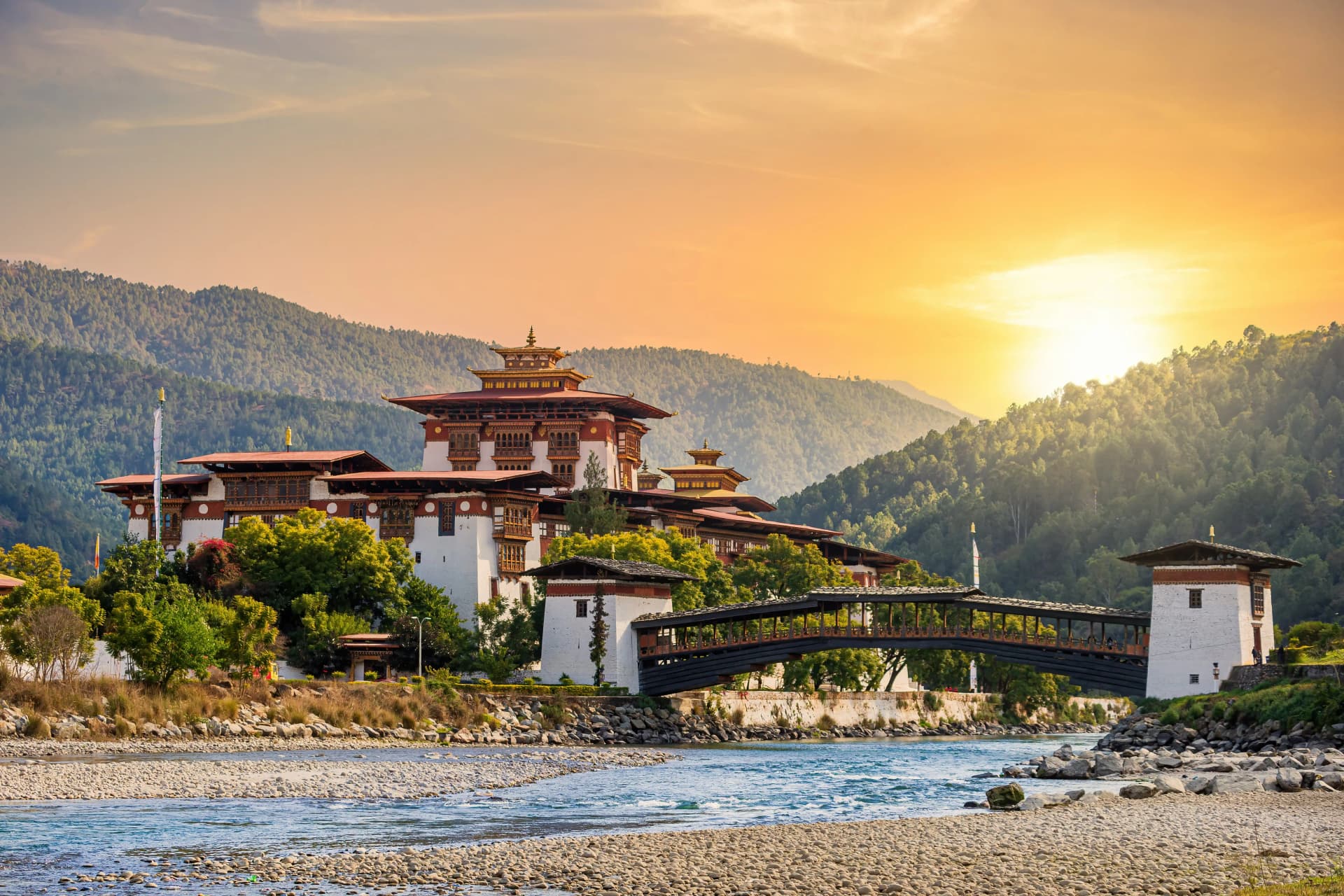
The festival takes place inside Tashichho Dzong — Bhutan's seat of central government and summer residence of the Je Khenpo (Chief Abbot). The dzong itself is a stunning whitewashed fortress on the banks of the Wang Chhu river, dating in its current form to 1968. Outside festival days the courtyard is closed to the public; during Tshechu it transforms into a vast amphitheatre filled with thousands of festival-goers.
A Centuries-Old Tradition
Thimphu Tshechu is one of Bhutan's longest-running annual celebrations. It draws Bhutanese families from across the country, foreign visitors timing their trips to the dates, and senior monks of the Zhung Dratshang (Central Monastic Body) who perform the sacred dances.
Tens of Thousands of Attendees
Where Kurjey Tshechu in Bumthang draws a few hundred local pilgrims, Thimphu Tshechu draws tens of thousands. The atmosphere is electric — Bhutanese families dressed in their finest gho and kira, food stalls around the dzong perimeter, traditional archery competitions on adjacent grounds, and a constant rotation of cham (masked dances) from morning through late afternoon.
2026 Dates
Thimphu Tshechu 2026: 21–23 September
Followed and preceded by:
- Thimphu Drubchen 2026: 17–19 September (the sacred prayer ritual that precedes Tshechu — see our separate guide)
Dates follow the Bhutanese lunar calendar. Your guide will confirm the daily cham programme on arrival.
What to Expect Each Day
Each day of Thimphu Tshechu features a different sequence of cham dances. While the exact programme varies year to year, the overall arc is consistent:
Day 1 (21 September): Opening
The festival opens with shorter ceremonial dances. The crowds build through the morning. This is a good day for first-time visitors to acclimatise to the rhythm — find your spot, watch how locals seat themselves, learn what the dances represent.
Day 2 (22 September): Main Programme
The longest day of cham, with the most varied dance programme. Highlights typically include:
- Shana (Black Hat Dance) — monks in black hats subduing evil spirits
- Guru Tshengye — the eight manifestations of Guru Rinpoche
- Dramitse Nga Cham — the UNESCO-recognised drum dance
- Dance of the Lords of the Cremation Grounds — fierce protective deities
- Dance of the Stags — depicting the conversion of a hunter to Buddhism
Day 3 (23 September): Closing
The final day includes the climactic dances and closing ceremonies. Crowds peak. Plan to arrive early — by 7-8 AM at the latest — for a good viewing position.
Why Thimphu Tshechu Over Other Festivals?
If you're choosing between Bhutan's major festivals, Thimphu Tshechu has specific practical advantages:
Easiest Logistics
| Factor | Thimphu | Paro | Kurjey (Bumthang) |
|---|---|---|---|
| Distance from airport | 1–1.5 hours by road | 30 min by road | 30 min by domestic flight OR 8–10 hours by road |
| Accommodation availability | Extensive (capital city) | Limited, books out fast | Very limited |
| Walking distance to venue | 5 min from central hotels | 10–15 min | Drive required |
| Festival duration | 3 full days | 5 days | 1–3 days |
| Crowd size | Largest | Very large | Small/intimate |
If you only have a 7-day trip, Thimphu Tshechu fits cleanly without dictating your entire itinerary.
Plenty of Cham Variety
Three days of full cham programmes mean you see a wide range of dances. This is unlike Kurjey, where you might see one signature dance, or Drubchen, where the focus is on prayer rather than performance.
Combine with Bhutan's Standard Loop
Thimphu sits in the middle of Bhutan's most-visited circuit (Paro – Thimphu – Punakha). A typical 7–8 day Tshechu trip:
- Day 1: Arrive in Paro — settle in, evening orientation
- Day 2: Tiger's Nest hike + Paro Dzong
- Day 3: Drive to Thimphu (1.5 hours), check in
- Days 4–6: Thimphu Tshechu (21–23 September) — three days at Tashichho Dzong, with afternoons free for Memorial Chorten, weekend market, Buddha Dordenma viewpoint
- Day 7: Punakha day trip — Punakha Dzong, Chimi Lhakhang
- Day 8: Return to Paro and depart
This is a turnkey itinerary our Bhutan Festival Journey tour is built around.
Add Drubchen if You Have an Extra Few Days
Thimphu Drubchen — the sacred prayer ritual at the same venue — runs 17–19 September, just before Tshechu. If you can extend by four days, you experience both the solemn and the spectacular sides of Bhutanese Buddhism. See our Thimphu Drubchen guide for a 12-day combined itinerary.
How Thimphu Tshechu Differs from Paro Tshechu
The two best-known tshechus draw different visitors. A quick comparison:
| Thimphu Tshechu | Paro Tshechu | |
|---|---|---|
| When | Late September | Late March / early April |
| Duration | 3 days | 5 days |
| Setting | Capital city, large dzong | Quiet valley, smaller dzong |
| Headline event | Variety of cham dances | The dawn Thongdrel unveiling |
| Best for | One-week practical trip | First-time visitors wanting THE iconic festival |
| Logistics | Easiest of all major Tshechus | Slightly more complex |
| Crowds | Largest (urban audience) | Very large (international visitors) |
Both are excellent. Choose Thimphu if convenience and a one-week timeline matter most. Choose Paro if you specifically want the Thongdrel ceremony and have flexibility on dates. Or read our complete Paro Tshechu 2026 guide to compare.
What to Bring
- Layered clothing — Thimphu in late September is typically 12–22 °C, with cool mornings and warm midday
- Light rain layer — September is the tail of monsoon; brief afternoon showers are possible
- Comfortable walking shoes — uneven dzong courtyards, long periods of standing
- A small cushion or scarf — for sitting on stone for hours
- Sun protection — hat, sunscreen, sunglasses (high-altitude sun)
- Modest dress — covered shoulders and knees; remove hats inside the dzong
- Camera with zoom lens — for cham dance photography from a distance
- Snacks and a water bottle — long days inside the dzong courtyard
Festival Etiquette
- Move clockwise around religious structures and prayer wheels
- Don't point your feet toward altars, monks, or sacred objects
- Ask permission before photographing locals
- No flash photography during dances
- Don't walk in front of seated viewers during performances
- Silence phones completely
- Stand if locals around you stand
- Accept any blessed offerings (water, cords, small icons) with both hands
Best Viewing Spots
The dzong courtyard fills early. Tips:
- Arrive by 7-8 AM each day — the best floor-level seats are gone by 9
- Upper galleries offer different perspectives but require even earlier arrival
- Bring a cushion — you may sit cross-legged on stone for hours
- Cluster near locals — they tend to know which spots have the best sightlines for upcoming dances
- Your guide will help secure positioning if you're with a tour
Accommodation in Thimphu
Thimphu has the broadest hotel range of any Bhutanese town — from luxury (Taj Tashi, Six Senses Thimphu, Le Méridien) to mid-range (Hotel Druk, Norbuling Hotel) to budget guesthouses. Tshechu week is the busiest hotel week of the year — book by June 2026 for good options.
Tour packages include accommodation booking, so you don't need to handle availability yourself.
Bhutan Tourism Rules — A Reminder
Foreign visitors need a licensed Bhutanese guide for cultural sites and trekking, plus permits, SDF, and a visa. We arrange:
- Tourist visa
- Sustainable Development Fee ($100 per person per night)
- Permits to enter Tashichho Dzong
- Licensed English-speaking guide
- Accommodation, meals, and transport
Independent travel is not permitted. For festivals specifically, your guide is the difference between a meaningful experience and three days of confused observation — they'll explain each cham dance as it begins, point out who the dancers represent, and tell you when the next major sequence is starting.
Ready to Plan?
Thimphu Tshechu 2026 falls on 21–23 September. Combined with Tiger's Nest, Paro Dzong, and a Punakha day trip, it makes a complete 7–8 day Bhutan trip — easily the most logistically simple way to experience a major Bhutanese festival.
Hotels fill quickly during Tshechu week. Book by June 2026 for the best rooms and rates.
Our Bhutan Festival Journey tour is the seasonal package built around festival dates exactly like this. Or, if you want a fully custom itinerary that combines Tshechu with Drubchen, Tiger's Nest, or any other Bhutan highlights, request a custom journey and our team will design a trip just for you.
Request to book — no payment yet →
Festival dates follow the Bhutanese lunar calendar. Schedule is confirmed with our local team closer to the event. [View full 2026 festival calendar](/bhutan-festival-calendar)